
Studio studies: Anna Rún Tryggvadóttir
There are moments when a landscape feels less like a place than a state of being.
One of the rewarding aspects of curatorial practice is the opportunity to gain rare insight into artists' studios. I have visited many studios of artists whose work, and ways of working, I admire; some have become close creative collaborators, while others continue to inspire my practice and my conversations around art. The exchange that takes place in the studio is often different from that around finished works. It happens while things are still unfolding; when ideas are exposed, forming, shifting and developing before they are released into the world.
Recently, I visited Anna Rún Tryggvadóttir in her studio, where she shared a new group of works with me. The space reflected a point of departure in her process: a moment when it becomes difficult to leave ideas and works in process, even briefly, and when living and making art become intertwined. The studio simply makes this relationship more visible, revealing the work in a state of becoming.
As she worked towards a new exhibition, the studio held a sense of openness and curiosity. It was a place where materials, life, and possibilities coexisted: stacks of special paper and tools within reach, watercolours drying on the floor, and sacred half-completed notes, fragments of thoughts, observations, and discoveries, scattered throughout the space. Among the works, a series of sketches immediately caught my attention. Their soft forms and shapes initially appeared to depict grasses and earth, waterways, or geological formations. Looking closer, though, I realized that bodies and landscapes were moving through one another.
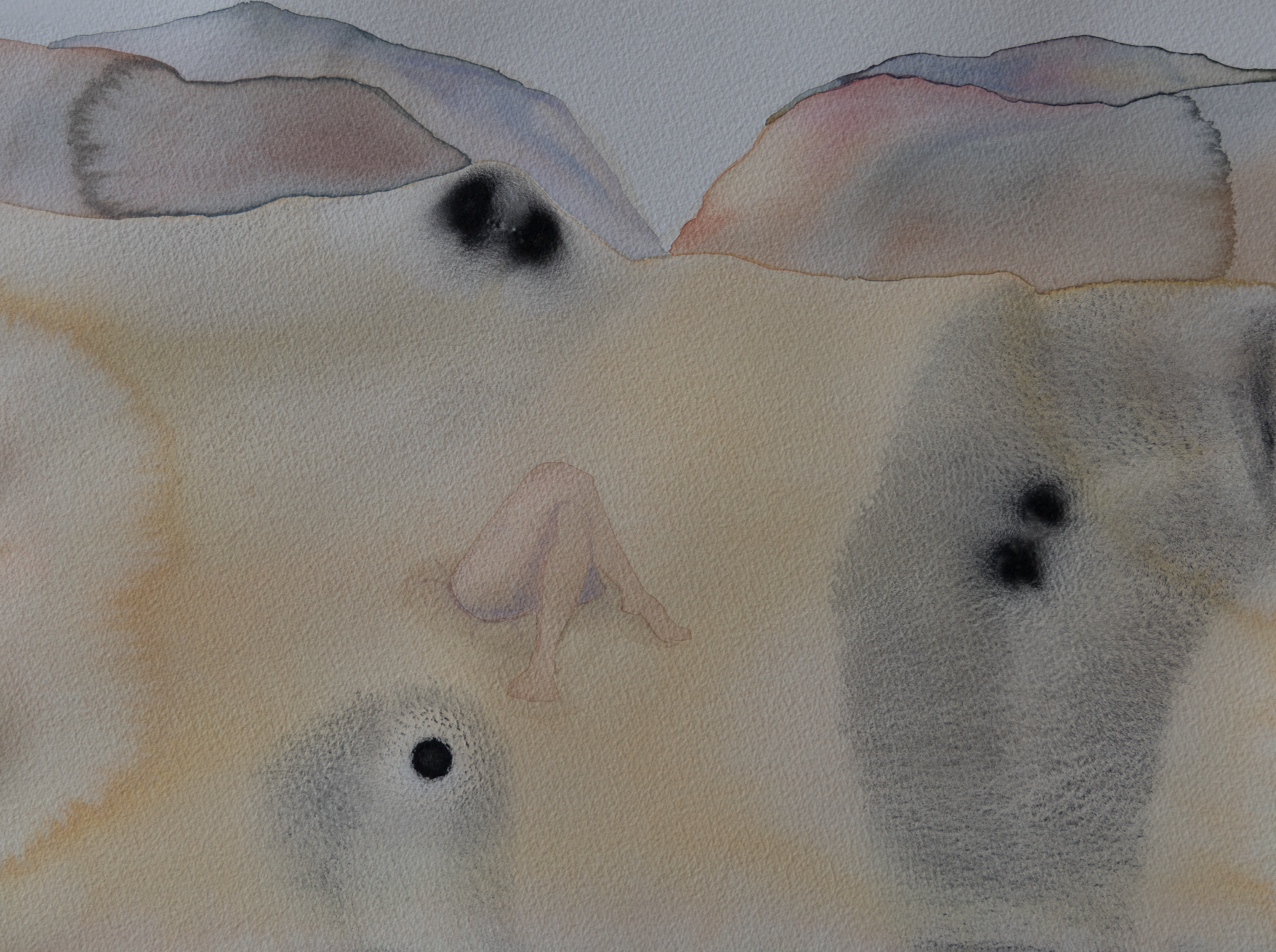
Figures of women surface from hillsides, drift through water, and disappear beneath layers of earth. They reappear elsewhere. Limbs become waterways; hair dissolves into currents. It becomes difficult to decide whether these figures are entering the landscape or emerging from it. In these drawings, the boundary between body and environment remains deliberately unsettled. A curve becomes a shoreline, then a shoulder, then the edge of a mountain. Earth becomes flesh.
What emerges is a sustained exploration of embodiment: the body not as something separate from the landscape, but as one of the ways through which landscape is sensed, inhabited, and understood.
What draws me to these works is the way agency circulates through them. In Anna Rún's installations, agency often belongs as much to materials and physical processes as it does to the artist. Here, that attention seems to extend to the body itself. Even when submerged, partially buried or folded into geological layers, the figures never appear passive. They are not overwhelmed by the landscape; they participate in its continual becoming. The works resist familiar narratives in which women are merely aligned with nature as symbols or metaphors. Instead, the figures seem to negotiate an ongoing relationship with the environments they inhabit. This relationship feels reciprocal rather than symbolic. Landscape acts upon the body, while the body simultaneously shapes, interprets, and moves through the landscape.
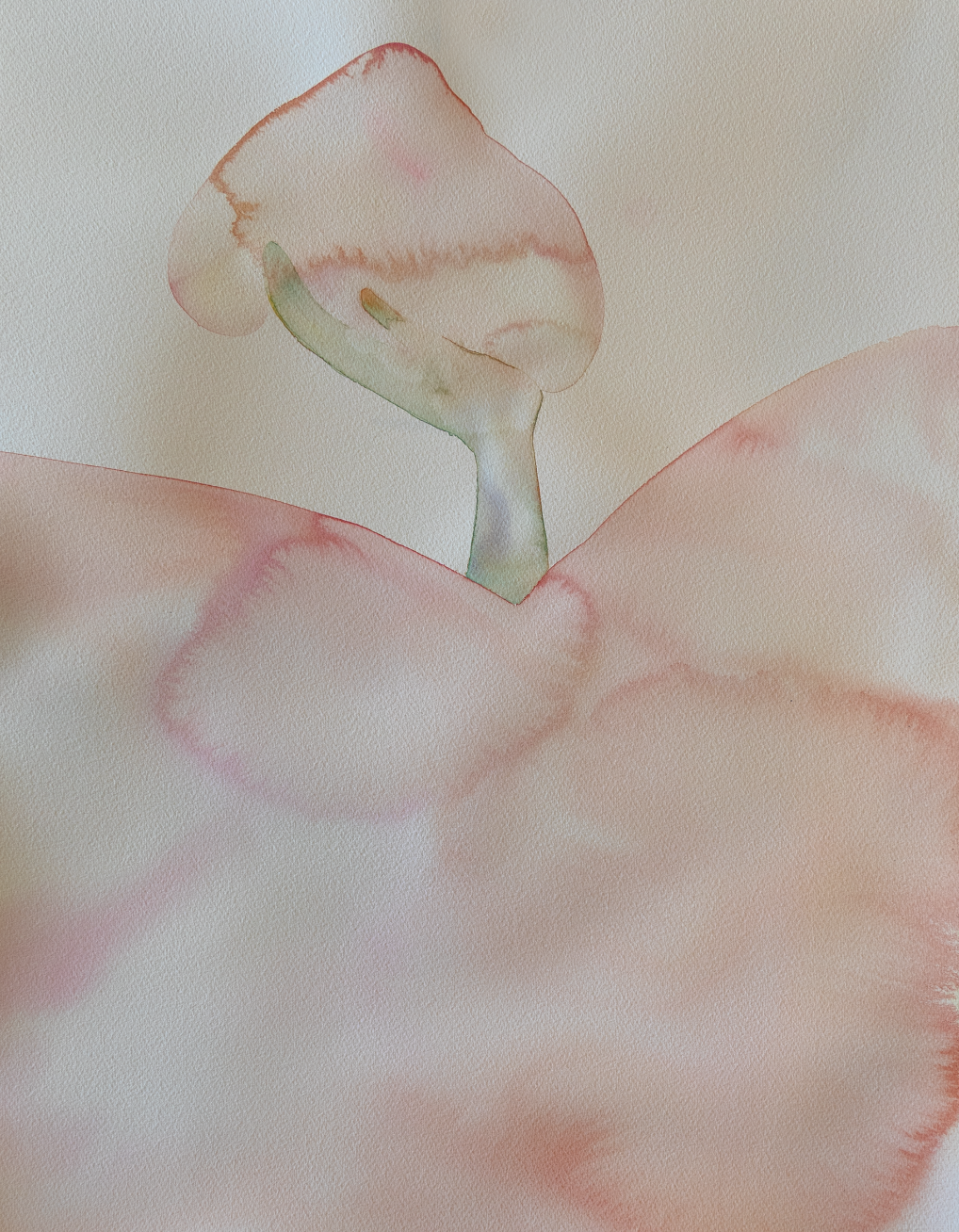
The visit with these drawings brought me back to questions that continue to occupy my own thinking: the relationships between women, art, land, rupture, and lineage; the way bodies carry memory of places, both familiar and unfamiliar; and how landscapes are experienced not only visually, but physically and emotionally. The figures happen to be female, but what makes the drawings compelling is that they ask how bodies, human bodies, exist as ecological bodies.
What happens when the body becomes a way of reading the landscape? Not as a metaphor, but as a sensory instrument. In Anna Rún's drawings, land is not simply seen; it is inhabited, remembered and felt. The body becomes a measure of environmental experience, just as the landscape becomes a record of movement, vulnerability and change. The works suggest a form of somatic knowledge—an understanding accumulated through sensation, proximity, memory, and lived experience rather than detached observation.
This might be one of the questions Anna Rún’s drawings, and new works, quietly pose. The landscape is not reflected on as something external to be observed from a distance. Instead it is encountered through memory, sensation, movement, and embodiment. The figures become both participators and interpreters of their surroundings, tracing connections between inner and outer worlds.
This body of work reveals a subtle change in emphasis within Anna Rún's practice. Her installations have long invited natural processes, salt, water, gravity, magnetism, to become active participants, asking us to reconsider our place within larger ecological systems. These drawings turn that attention inward. Rather than constructing an environment around the viewer, they trace an embodied landscape where geological and emotional experience become inseparable. The same questions of relation, transformation, and agency remain, but they are carried here through figures whose bodies move with, rather than across, the land.
The material language of the works reinforces this fluidity. Watercolour pools, stains and spreads according to its own rhythms. Pigment follows gravity. Pearly colour bleeds into other colours. Looking at the drawings, I thought of Helen Frankenthaler's willingness to allow water and pigment to become collaborators in the image-making process. Anna Rún similarly embraces uncertainty, allowing forms to emerge through accumulation rather than control. The materials themselves seem to participate in the work's exploration of relation and agency. Pigment follows its own course, water leaves traces of movement, and forms emerge through a process of responsiveness rather than control. The resulting images feel less composed than grown. Yet unlike Frankenthaler's largely abstract compositions, bodies remain insistently present. Vivid, looping coloured-pencil lines gather into formations that resemble waterways, root systems, veins and weather patterns simultaneously. Figures surface repeatedly throughout the works, though rarely as complete or stable forms. They are embedded within mountainsides, carried by currents, held within layers of colour and sediment. Their boundaries remain porous.
The drawings call to mind a lineage of women artists who have explored the relationship between body and earth as a site of transformation. Ana Mendieta’s Silueta works are an obvious touchstone, but Anna Rún’s figures seem less concerned with leaving traces in the landscape than with imagining a state of belonging within it. They do not stand apart from the terrain (environmental and inner, spiritual). They appear to be generated through it.
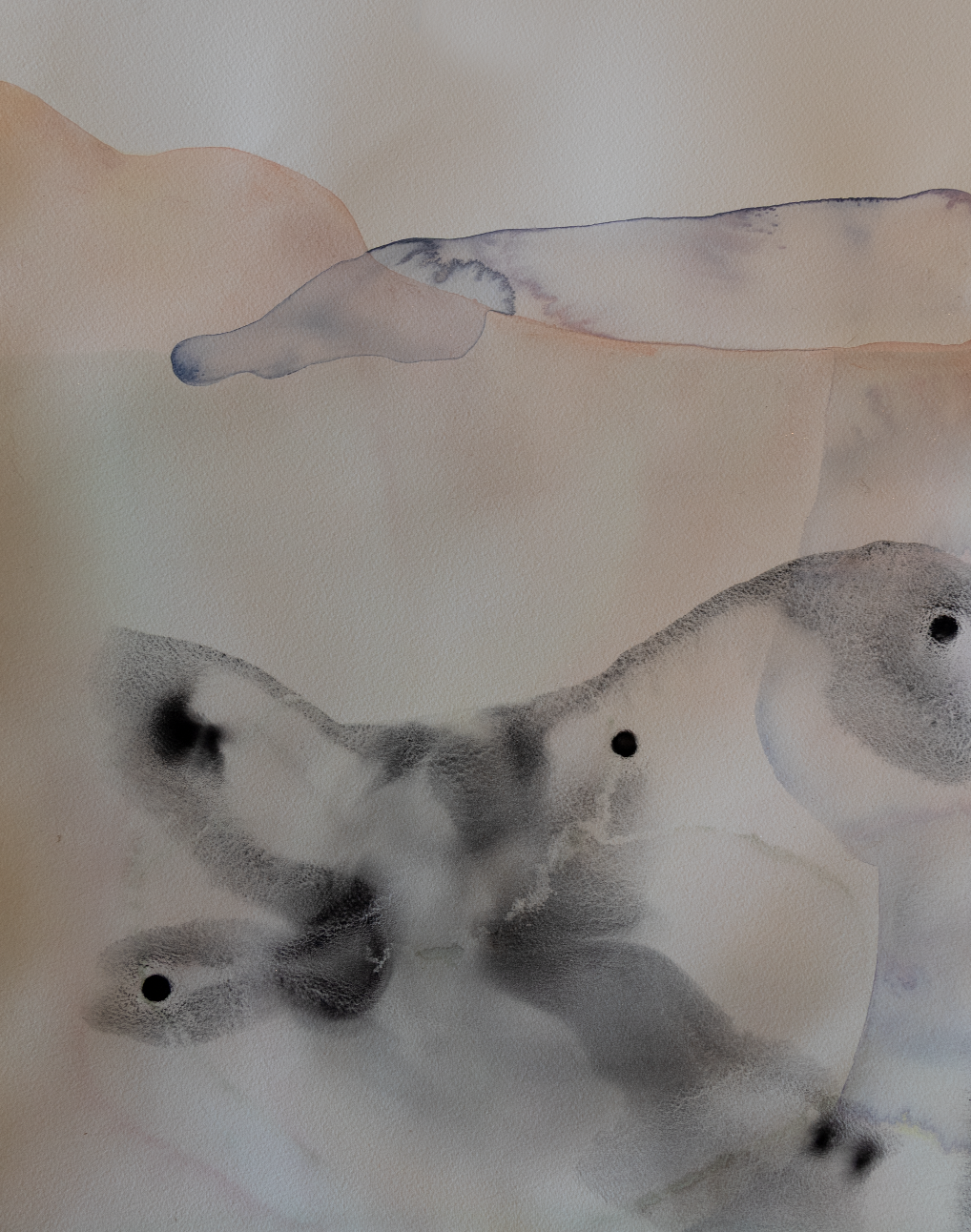
Looking at these cycles of transformation and accumulation, I found myself thinking about matrilineal forms of knowledge. Not the matriarch as a symbolic figure, but the quieter ways understanding is carried through generations through observation, repetition and care. Through gardening, storytelling, caregiving, observation, making and tending. Through learning when berries ripen, when weather shifts, when seeds are ready to collect. Through practices that unfold slowly and are often transmitted through example rather than instruction.
This too is a form of somatic knowledge: knowledge held in the body, learned through doing, and carried through generations not as information but as lived experience.
Perhaps this is why the figure of the matriarch lingers at the edges of Anna Rún’s drawings. Not as an archetype or symbol, but as a carrier of memory and experience. A presence shaped by continuity, attentive to inherited ways of understanding the world, where learning occurs through proximity and participation.
Forms are repeated, altered but recognisable. A body becomes a mountain. A mountain becomes a wave. A wave becomes a gesture. Meaning emerges through recurrence as works resist linear narratives in favour of cycles, suggesting that transformation is not an event but a condition of living.
There is something kind of radical in this refusal of fixed boundaries. Feminist philosopher Luce Irigaray wrote of fluidity as a challenge to systems that privilege solidity, hierarchy and separation. Anna Rún's drawings seem to move through similar territory. They seep, gather, dissolve and return, proposing a world in which identity is not fixed but continually shaped through contact with other bodies, histories and landscapes.
In an era increasingly defined by environmental uncertainty, the works offer neither warning nor escape. Instead, they propose another way of understanding change itself. Transformation is not presented as catastrophe but as continuity. The figures move through states of immersion, emergence and return without losing themselves entirely.
Perhaps this is what lingers with me after leaving the studio. Not a single image or narrative, but a feeling. That the boundaries we draw between ourselves and the world are more fragile than we imagine. That landscapes move through us as much as we move through them. That embodiment, somatic knowledge, and reciprocation are not separate conditions, but intertwined ways of understanding how we exist within larger ecological and ancestral systems. And that beneath the surface, forms of knowledge continue to flow quietly between generations, waiting to be recognized.
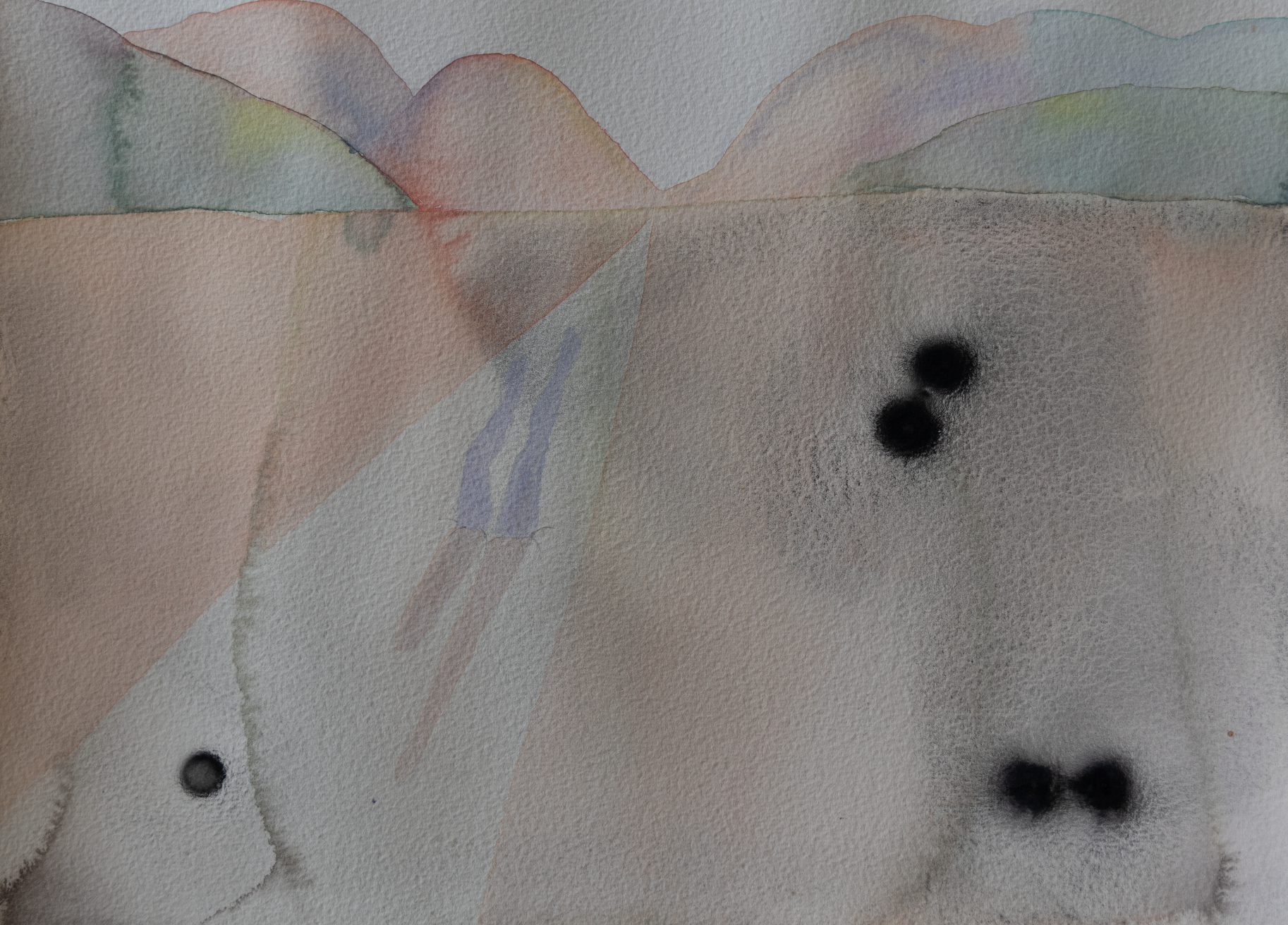
Images: Courtesy of the artist
— Becky Forsythe
