
The Canon in Question: Carl Andre at the National Gallery
I asked the curators how they considered the decision to show Carl Andre’s work in light of the contested history of Ana Mendieta’s death.
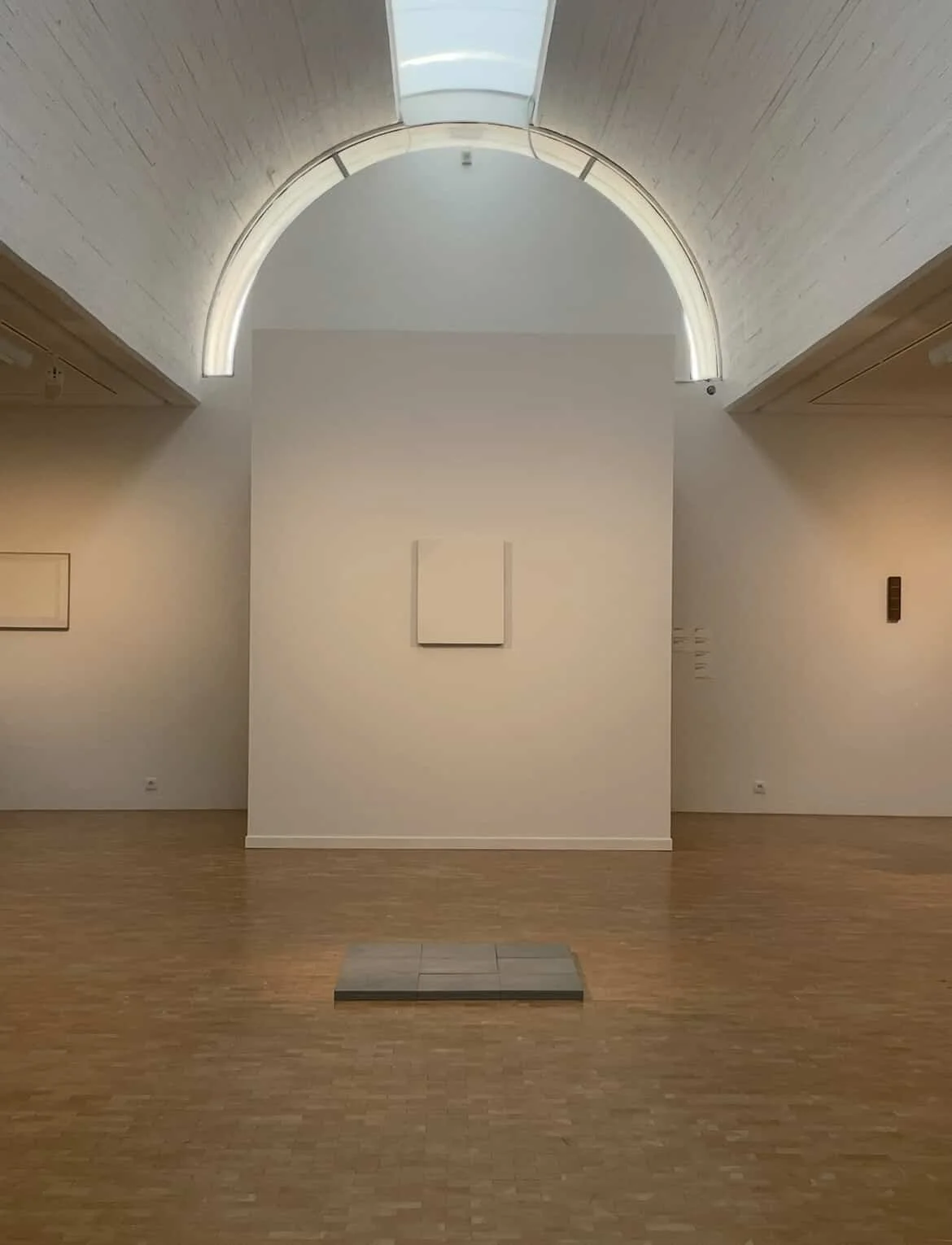
In January, the National Gallery of Iceland opened Affinities of Form: Artistic Convergences in Iceland since 1970, a group exhibition of works by Icelandic and international artists associated with land art, conceptual art and minimalism. Among the works shown is Carl Andre’s (1935–2024) Altabase 27 from 1996, alongside works by Hreinn Friðfinnson (1943-2024), Ingólfur Arnarson (1956), Ragna Róbertsdóttir (1945), Richard Serra (1938-2024), Roni Horn (1955) and others whose practices ask questions of form and material. Curated by Pari Stave and Gavin Morrison, the exhibition foregrounds aesthetic relationships across geographies by tracing affinities in materials, scales and spatial thinking.
In the days following the opening, I had several conversations with exhibition-goers who approached me to say that they found it difficult to encounter Carl Andre’s work in the exhibition alongside artists they admire. For them, this discomfort was connected to Andre’s relationship to Ana Mendieta, his wife, and to the contested circumstances of her death in 1985. This story was revisited by Helen Molesworth in the podcast series Death of an Artist in 2022, whose rigorous research informs much of the factual groundwork of this article. Regardless of the court’s ruling of Andre’s guilt or innocence, the case is unresolved in the cultural imagination and has prompted protests when his work is exhibited. My conversations with exhibition goers raised questions I would like to explore such as why was this history excluded from the curatorial framework of Affinities of Form? What does that exclusion reveal about how the institution decides which contexts are permitted to shape an exhibition and which stories are left outside its frame? And how can the conversation go on from here?
Before these questions are interrogated it is important to delve briefly into the life and untimely death of Ana Mendieta. Ana Mendieta (1948–1985) was a Cuban American artist of Afro-Cuban descent whose work emerged from experiences of exile, displacement and bodily vulnerability. Her practice, which combined performance, land art, photography and ritual, placed the body at the centre of questions of identity, violence and belonging. Mendieta died after falling from the 34th floor of the New York apartment she shared with her husband, the minimalist sculptor Carl Andre. Andre was arrested and charged with her murder but acquitted in 1988 after a bench trial, the court ruling that there was insufficient evidence to prove guilt. While the case was legally closed, it has remained culturally unresolved. For many artists, scholars and activists, particularly those attentive to gender, race and inequality within the art world, Mendieta’s death and subsequent marginalisation have come to symbolise how institutions often separate canonised work from uncomfortable histories. This unresolved tension has led to repeated protests at museums in the United States and the United Kingdom, with demonstrators asking why Mendieta’s life and work continue to be sidelined while Andre’s are repeatedly celebrated.
On 1 February, I attended a public curator talk of Affinities of Form at the National Gallery. I remember feeling my heart rate rise when I saw the work. I felt a mixture of numbness and sadness, and an uncomfortable physical tension between the work and my body. I wanted to know exactly why Carl Andre’s artwork was there, why it had been placed so prominently in the middle of the room, and the curators’ reasoning for that choice. This prompted a broader reflection. Do curators have a responsibility to consider the histories attached to works as part of their curatorial process, even if those histories are not made explicitly visible within the exhibition itself? When I asked curators Pari Stave and Gavin Morrison how they considered the decision to show Carl Andre’s work in light of the contested history of Ana Mendieta’s death, they acknowledged that it had not come up in their curatorial conversations. Both curators emphasised stating clearly that Andre was not convicted of murder, including that there were no witnesses to Mendieta’s death. Some audience members acknowledged that this history inevitably “sets a tone” for the exhibition, even if it is not directly addressed. Differing curatorial positions also became visible. Gavin spoke about his interest in how Minimalism operates in dialogue with the human body and the viewer, and expressed that it would be a loss not to show Andre’s work, particularly given Andre’s connection to Iceland and the museum’s collection. Pari, by contrast, articulated a desire to keep the focus on the work itself rather than on the artist as a person, seeking to disconnect the art from biographical narratives.
When I raised the controversy surrounding Carl Andre, Pari also noted that Richard Serra, another artist in the exhibition, had likewise been the subject of controversy. This comparison, in my view, is not so relevant. Serra’s disputes are most notably around the removal of Tilted Arc. These debates centred on issues of public space, aesthetic imposition and the limits of site-specific art. The massive sculpture, installed in New York’s Foley Federal Plaza intentionally obstructed the plaza, sparking intense public backlash that ultimately led to its removal in 1989. Andre’s, by contrast, remain inseparable from the unresolved cultural memory surrounding Ana Mendieta’s death and the gendered dynamics that continue to shape its reception. To position these controversies alongside one another risks flattening different forms of discomfort into a single narrative of resistance to challenging art. While both artists have provoked public debate, the stakes and ethical dimensions of those debates diverge significantly.
The curators’ decision to keep interpretation to a minimum in the exhibition reflects a belief in restraint and in allowing works to be encountered directly. Silence here is positioned as respect for the autonomy of the artwork and for the intelligence of the viewer. At the same time, silence is never neutral. More crucially, in the history surrounding Carl Andre, silence has played a significant role. During Andre’s trial following Ana Mendieta’s death, Andre did not speak publicly, and many within his circle discouraged people from attending. Under the guise of sensitivity and privacy, access to the proceedings was limited, and few encountered the testimony or evidence directly. What complicates this further is that despite claims that art should stand apart from biography, Andre’s work was not separate from the trial. His work, associated with purity and order, was implicitly invoked in his defence, while Mendieta’s work, with blood, earth and the body, was framed in ways that allowed it to be read as evidence against her. In the courtroom, art did not simply speak for itself. It was interpreted and construed, essentially placing it in direct relation to the character of the artists.
It is also worth noting that Affinities of Form also features works by Lawrence Weiner (1942–2021), a close friend of Andre. After Mendieta’s death, Weiner quickly helped Andre secure a lawyer to raise bail. Calls went out to sympathetic friends, including the painter Frank Stella, who arranged a check through his bank. These stories matter not as gossip, but because they remind us that artistic movements are not only formal languages. They are social networks, sustained through friendship, influence and mutual protection. Everything is intertwined. And yet we continue to celebrate a movement largely shaped by white men whose careers often appear curiously insulated from consequence or controversy. Sounds familiar? At any rate, the question is not whether Carl Andre’s work should be shown. It is rather about how institutions can hold space for complexity without foreclosing the experience of art itself. Perhaps, by acknowledging a history that many viewers already know, the work might be encountered with greater openness rather than greater tension. Silence does not necessarily protect the work. It may instead bind it more tightly to what remains unspoken.
The decision to not discuss Mendieta’s death when choosing to show Andre’s work could and does communicate a particular set of institutional values. In this case, the claim that the issue was not discussed or that the acquittal should close the matter is itself an interpretative stance. It privileges formal art historical narratives over embodied histories and separates the art object from social histories of gendered violence and institutional power, regardless if that was the intention or not. Granted, art museums are not courts of law, but they play a significant role in shaping public understanding. Including context about why controversies persist does not adjudicate guilt, but it does acknowledge the broader cultural histories that inform how art is received. For a national gallery in particular, which speaks on behalf of collective heritage and cultural memory, engaging with contested histories can deepen public engagement and strengthen institutional accountability. Given that both curators have lived and worked extensively in the United States, it is worth asking whether the museum’s location in Iceland creates a sense of safe distance from these debates.
There are of course other histories that complicate the Carl Andre–Ana Mendieta story. For example, Carl Andre was himself one of the founders of the Art Workers’ Coalition (AWC), a movement that challenged museums to become more open, democratic and attentive to the exclusion of women artists and artists of colour. This contradiction is part of what makes this story so difficult and important to sit with. Returning to the AWC’s demands today invites reflection and I wonder how institutions might continue to broaden whose work is made visible and whose stories are treated as central to art history.
Installation view at the National Gallery.
I want to shift the mood of this article. Rather than framing it solely as a critique, I want to widen the conversation about how we can engage with artistic legacies that are complex, unresolved and emotionally charged. This article is not intended as a dismissal of Affinities of Form, which is a carefully considered and visually compelling exhibition. Rather, it takes the show as a starting point for reflecting on the evolving role of national galleries and curators, not as arbiters of closure but as hosts of open, evolving conversation. Both Pari Stave and Gavin Morrison reached out in the evening and days following the curator talk to thank me for raising this question publicly and expressed willingness to continue the discussion. That openness matters, and it suggests that these conversations are not only necessary, but entirely possible.
In the weeks following the talk, Pari and I met at a café to continue the conversation. She began by saying how much she valued my question, appreciating that it did not end with the public event but continued in a space where we could sit with it more carefully. “I’m glad we can have an open conversation,” she said. That tone of openness shaped everything that followed.
Pari described Affinities of Form as emerging from a close re-engagement with the National Gallery’s collection. For her, the show was conceived as a way of looking again at what works had been preserved, what relationships could be drawn out and where gaps became visible. When installed together, the works would, as she put it, “speak for themselves and speak for each other.” The decision to keep wall text minimal was shared by both her and Gavin. For them, restraint was not about withholding context but about allowing the objects in the room to be encountered. Much of the interpretative material was therefore placed in the handout rather than on the walls.
When I later exchanged emails with Gavin, he situated the exhibition within its broader curatorial logic. The show, he explained, grew out of conversations about the connections between Icelandic and international artists working in relation to minimalism and land art from the 1970s onward. Within that framework, Carl Andre’s basalt work was not incidental. It was gifted to the museum after his 1996 exhibition for Reykjavík Art Festival, and its material was chosen through careful research into Icelandic resources. Given those parameters, Gavin felt that excluding the work would have been difficult to justify. At the same time, he acknowledged that Andre’s work now carries what he called a “meta-narrative” tied to Ana Mendieta’s death and to broader histories of gendered violence. He noted the irony that such an austere, seemingly anonymous stack of basalt tiles can evoke such strong emotion. Minimalism’s claim to autonomy from biography is unsettled by the fact that viewers do not encounter the work in a vacuum. Still, he leans toward allowing the art to do as much of the work as possible, minimising didactic framing and avoiding dictating how those tensions should be processed.
Pari, too, recognised that Carl Andre’s reputation will never be entirely separable from his life. Whether or not that history appears in a wall label, “it is his reality,” she said. After the talk, she acted quickly to address my question in the workplace. She met with museum staff to discuss the work and its reception, and prepared written guidance so front-of-house staff would feel equipped to respond to questions. During a Museum Night tour, she experimented with addressing Mendieta’s death directly. The moment did not quite land. Visitors seemed unsure how to situate the information within the flow of the exhibition. But it was an attempt, and it mattered. Audience feedback also shaped this process. One artist visitor said they understood Andre’s inclusion but questioned the placement of his work, positioned prominently “in the middle of the floor.” That comment lingered. It revealed how spatial decisions can communicate emphasis regardless of curatorial intention. Genuine museological discourse, as Gavin reflected, is possible, but it relies on an engaged public most importantly curators and museum directors willing to stay in or open up dialogue.
What I valued most in meeting Pari and corresponding with Gavin was their willingness to stay in the conversation, to sit with discomfort rather than pretend it doesn’t exist. We do not fully align, and I remain uneasy about what institutional silence can reproduce. Gavin wants the work to speak for itself while still recognising its charged context. Pari holds fast to the aesthetic framework of the exhibition, yet experiments, adjusting mediation in response to audience feedback. For my part, I could never bring myself to exhibit Carl Andre’s work. That’s simply my perspective. Our methods diverge, but there is no right or wrong here. Speaking these differences aloud and testing them is the work. It is rewarding and exciting, and it reminds me of why I am a curator.
I began this reflection unsettled. I still am, but with more clarity about why. The discomfort has not disappeared but it has revealed how it can move between artist, curator, institution and audience. Gavin noted that curators can get comfortable in the ivory tower when they step back from difficult conversations or assume aesthetic autonomy will do the work for them. It is an easy position to occupy. Sitting in that café, exchanging emails, returning to the gallery floor, I realised how grateful I am to have these conversations. When I first encountered the sculpture, my question to Pari and Gavin was not about why it was there, but: about how Carl Andre’s contested history was discussed in the curatorial process. I asked this because I thought it could be an opportunity for myself to learn something, and I have. His artwork remains in the middle of the room and so do many questions. I learned that museums cannot simply display work if they want to engage meaningfully but they have to stay in the conversation. And perhaps that conversation could lead somewhere unexpected, like towards new ways of mediating contested artworks, toward further identifying gaps in programming, asking who is placed in the canon and who is not, toward taking risks and testing things out.
— Helena Solveigar Aðalsteinsbur
Sources:
