
Review: The many beating hearts of Bonita
Now that I live in the countryside, I try to use my time in Reykjavík wisely. I want to see the art that might unexpectedly surprise me, move me or make me feel hopeful about the scene. I was in the city for a few days before heading north recently, but hadn’t managed an exhibition crawl. At the time, my son was ten months old and still breastfeeding, so outings without him were rare and brief. I enjoy bringing him to openings, he was six weeks old with me installing his first show in the east, but conversations with artists and colleagues can be difficult to navigate, not only because of the logistics around a baby, but also my ADHD, which remains undiagnosed.
I had my heart set on seeing Hugo Llanes’ Bonita in D-Gallery at the Reykjavík Art Museum. I felt an urgency, catching it just after opening seemed essential, and meeting Hugo felt like a small dream. After congratulating him over messages, we realized he would be around in the exhibition the day after. With some negotiation around nap schedules and a bit of chance, we met at noon in the exhibition. Hafnarhús still carried the residue of the opening the day before; the faint scent of hot dogs, jalapeños and pineapples lingered. The day prior Hugo had served guests the national symbol of Iceland, pylsur or icelandic hotdogs, with a mexican twist as a participatory performance.
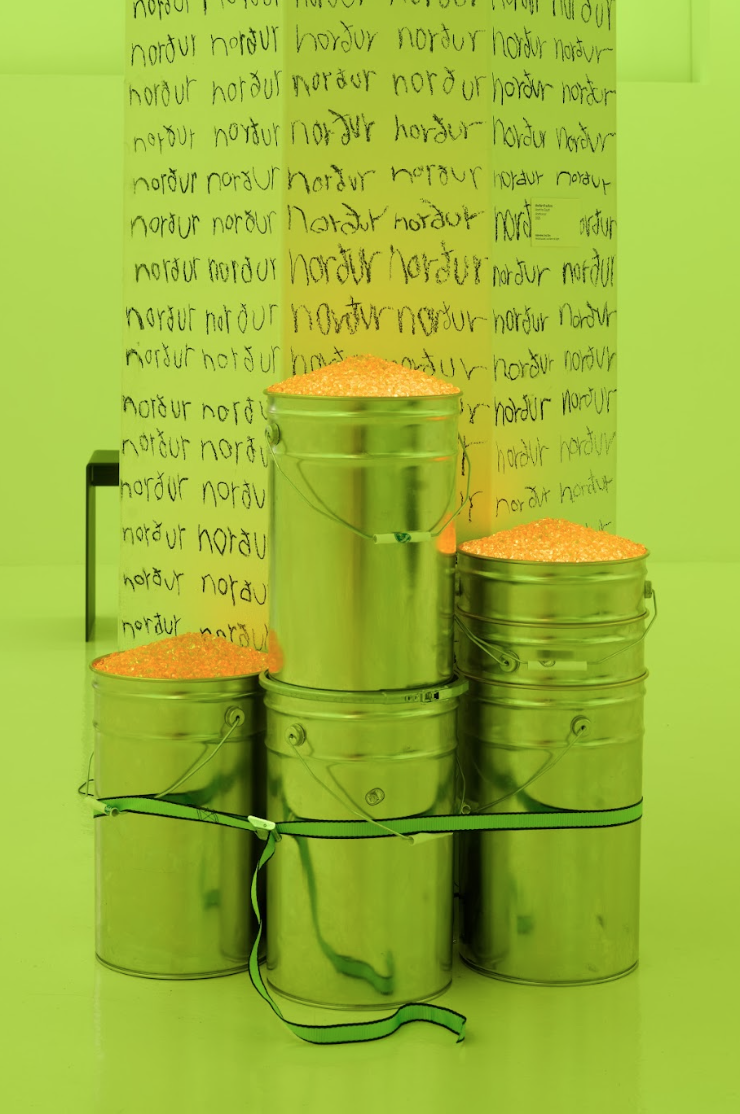
Walking in, Hugo’s presence in the space was immediately felt. He moved generously between guests, offering details behind the works. I lingered behind pillars inscribed repeatedly with “norður” (north) written in a looping hand. Hugo, who is from Mexico, is now inseparable from Reykjavík’s art and underground music scene, having been part of it for over a decade.
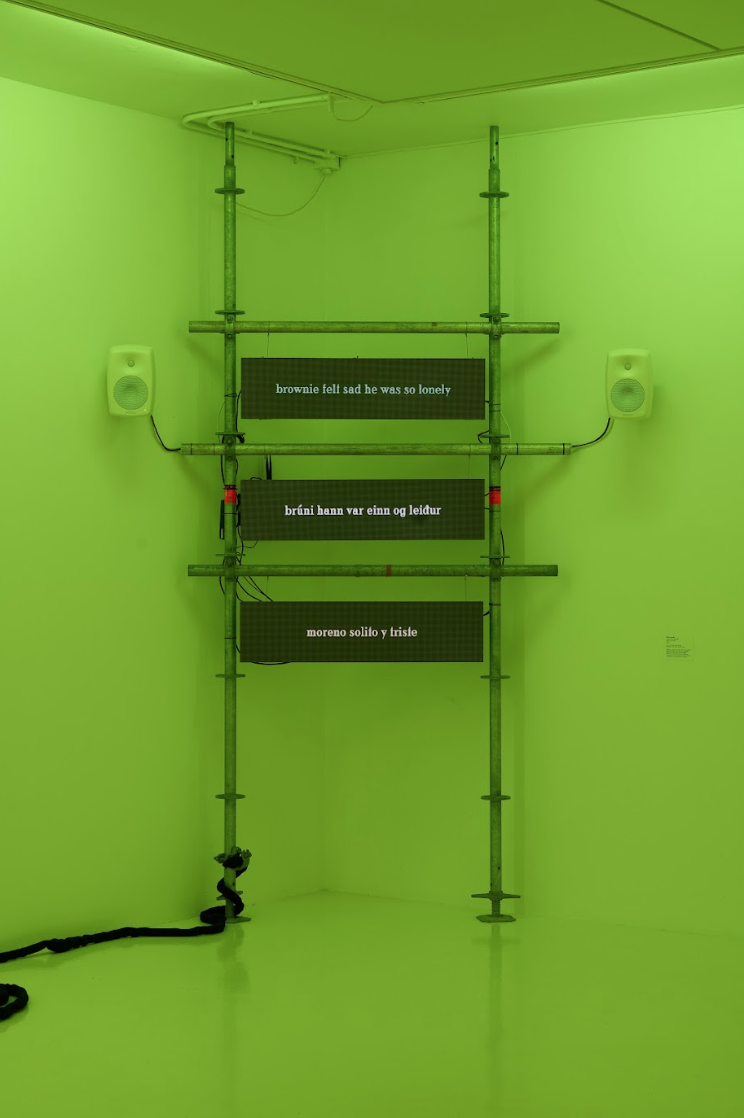
Bonita is, in many ways, a heartbreaker. It carefully holds the multitudes of existence as an outsider in a foreign country, the highs and the lows. Punk energy runs through the space; GRÓA, Icelandic female-led band, contributes a recorded performance, reworking lyrics from the original song from the 1990’s Mexican female-led band Las Ultrasónicas into a story of a gay couple in Iceland: Moreno y Güero. At the heart of the exhibition lies the figure of Bonita, she is birthed into being at the intersection of Hugo’s lived experience of being a foreigner, being queer, being from the global South. She navigates that intersection of alternative realities of belonging. Interacting with one of Iceland’s most iconic modern art figures creating a reflection between past and present, personal and national identity. Bonita, to me, has many beating hearts. They beat to different rhythms that find harmony in the space at Reykjavík Art Museum.
As an Icelander, parts of the show struck deeply, references to my youth, familiar music, shared symbols. At moments, I found myself unexpectedly emotional. Still, woven through this familiarity, were elements that felt foreign enough, yet uncannily close, entangled with overlapping cultural references and emotional registers. My own lived experience seemed to flicker at the core of the work, alongside Hugo’s, shaped by love, migration, and the tension of belonging both here and elsewhere, in the global South.
Curated by Björk Hrafnsdóttir, the exhibition carries a quality reminiscent of a national pavilion at Venice Biennale. It is like a retrospective, yet a solo show, a futurespective containing so many layers, so many surprises, textures, mediums and details to be discovered, both loud and quiet, punk and telenovela. For those going to Venice this is the perfect preempt as it closes on May 3, right before the previews. It presents queer multitudes, experiences that invite recognition, or at least proximity to a fragmented reality of wanting to stay while never fully belonging.
Still, there is light. One of the central works is 555, a hand-tufted textile from black Icelandic wool and Mexican natural-colored wool of an enlarged ticket from Útlendingastofnun (Directorate of Immigration), the last Hugo received when collecting his permanent residency. A plastic mango spills across the work of what looks like shiny golden pearls onto the rug. Nearby, buckets of the same pearls of Lýsi (Icelandic cod liver oil capsules) tablets mimic pots of gold in the work North to south. The gesture could tip into irony, but it doesn’t. The exhibition remains generous, sincere and inventive, qualities that feel inseparable from Hugo himself.
— Þórhildur Tinna Sigurðardóttir
Images by Vigfús Birgisson
