
Review: Stories told during nap-time
There’s a particular kind of giddiness that seems to only surface when something feels both uncannily new and already sedimented in your bones. Hljóðskraf – A Not a Play, the duo exhibition by Halla Einarsdóttir and Nína Harra at Associate Gallery, opened on the first day of summer with precisely that charge. It felt surprising, largely new, yet threaded with something ancient, like a story you half-recognise before it’s even told.
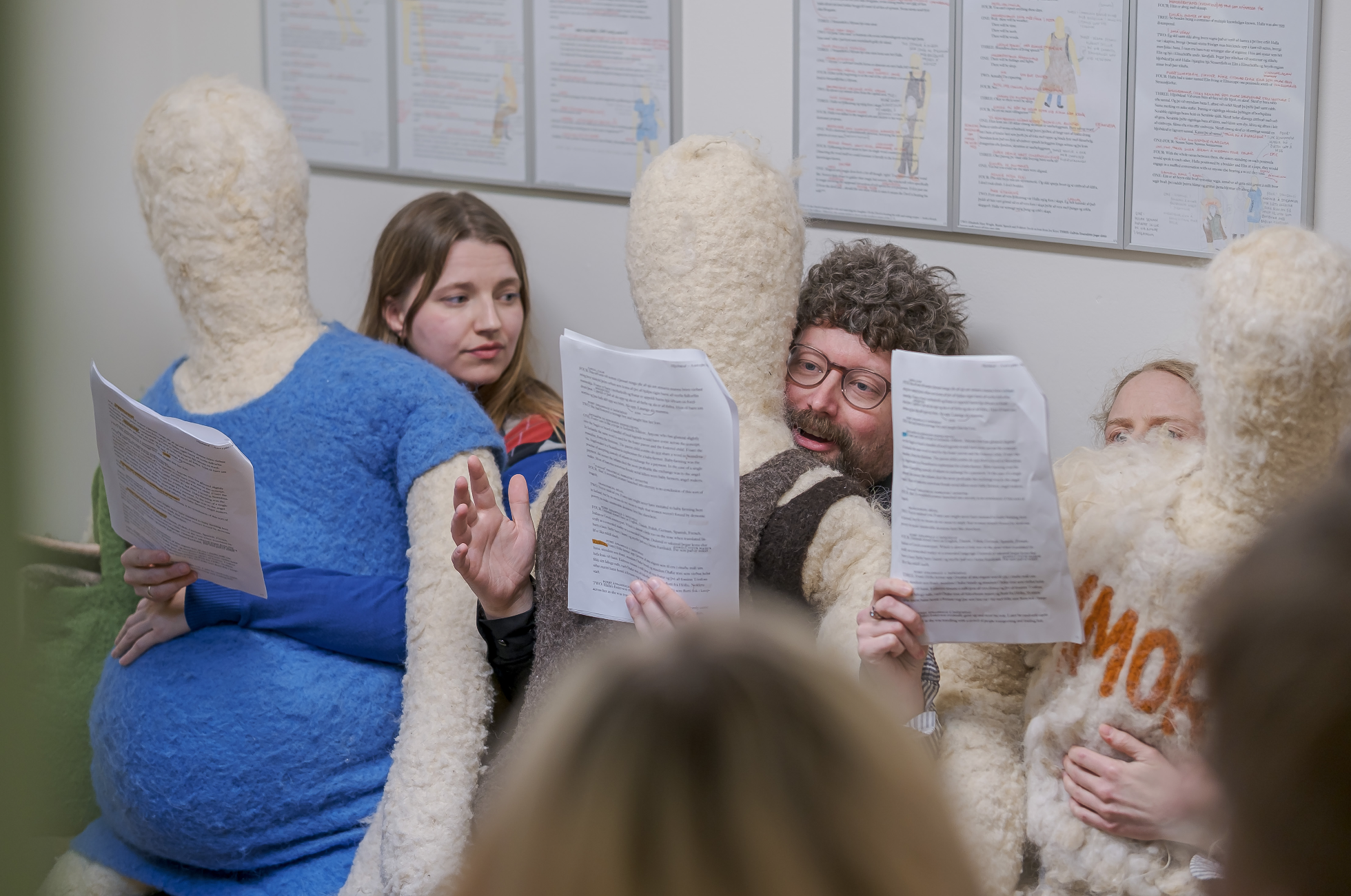
Structured as a performance in four parts, I arrived at the end and stayed through the beginning, catching acts four and one in that order. It didn’t matter, or rather, it mattered in exactly the way the work intended, as time refused to behave. Walking into the small gallery, where the audience stood and sat among the performers, I was met by life-size human sculptures in felted wool: soft, bodily and slightly uncanny. One reclined on the floor, another perched, pregnant, on a staircase, while two sat on a bench. They felt like stand-ins, witnesses, inhabitants or even residues.
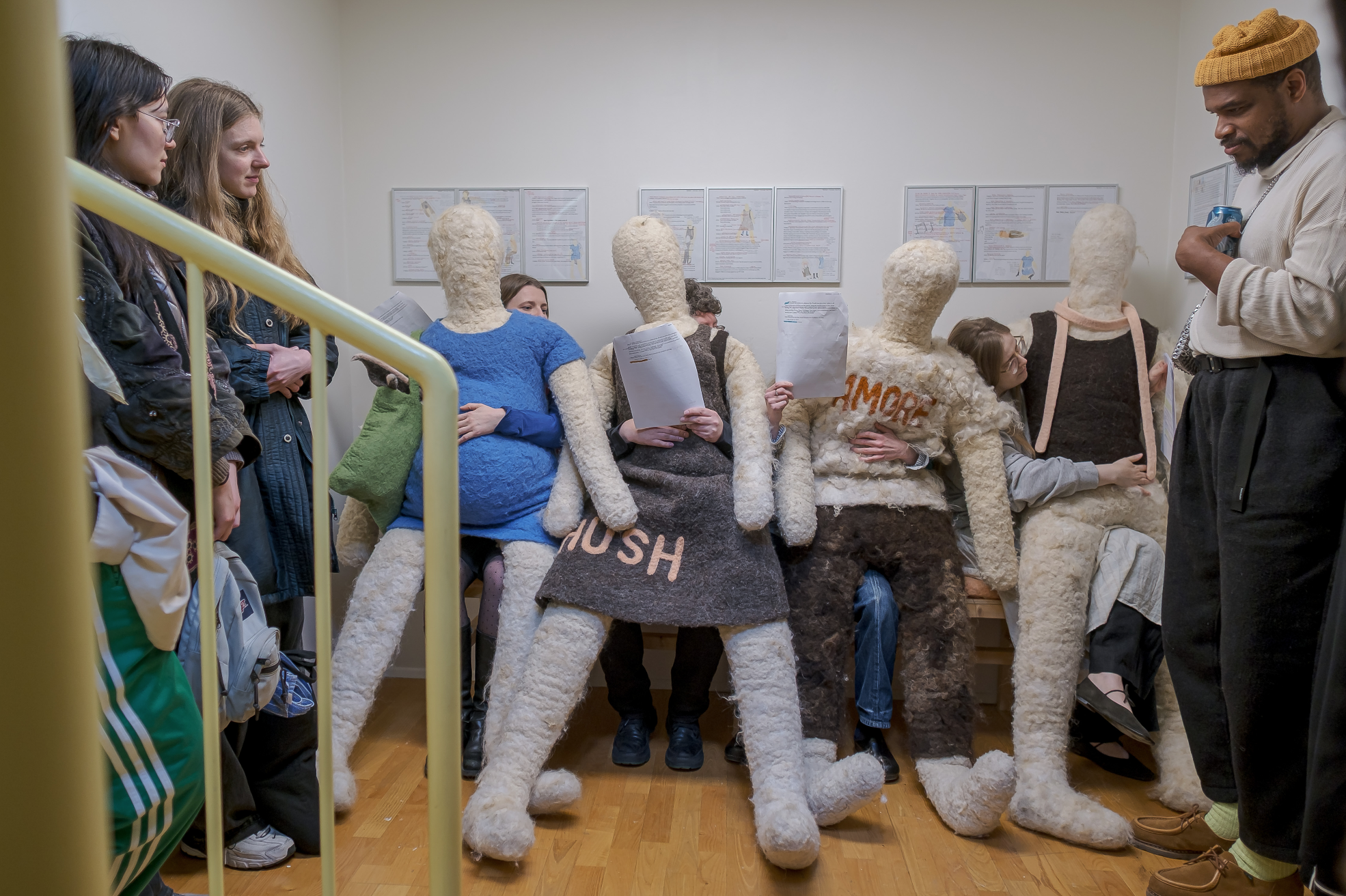
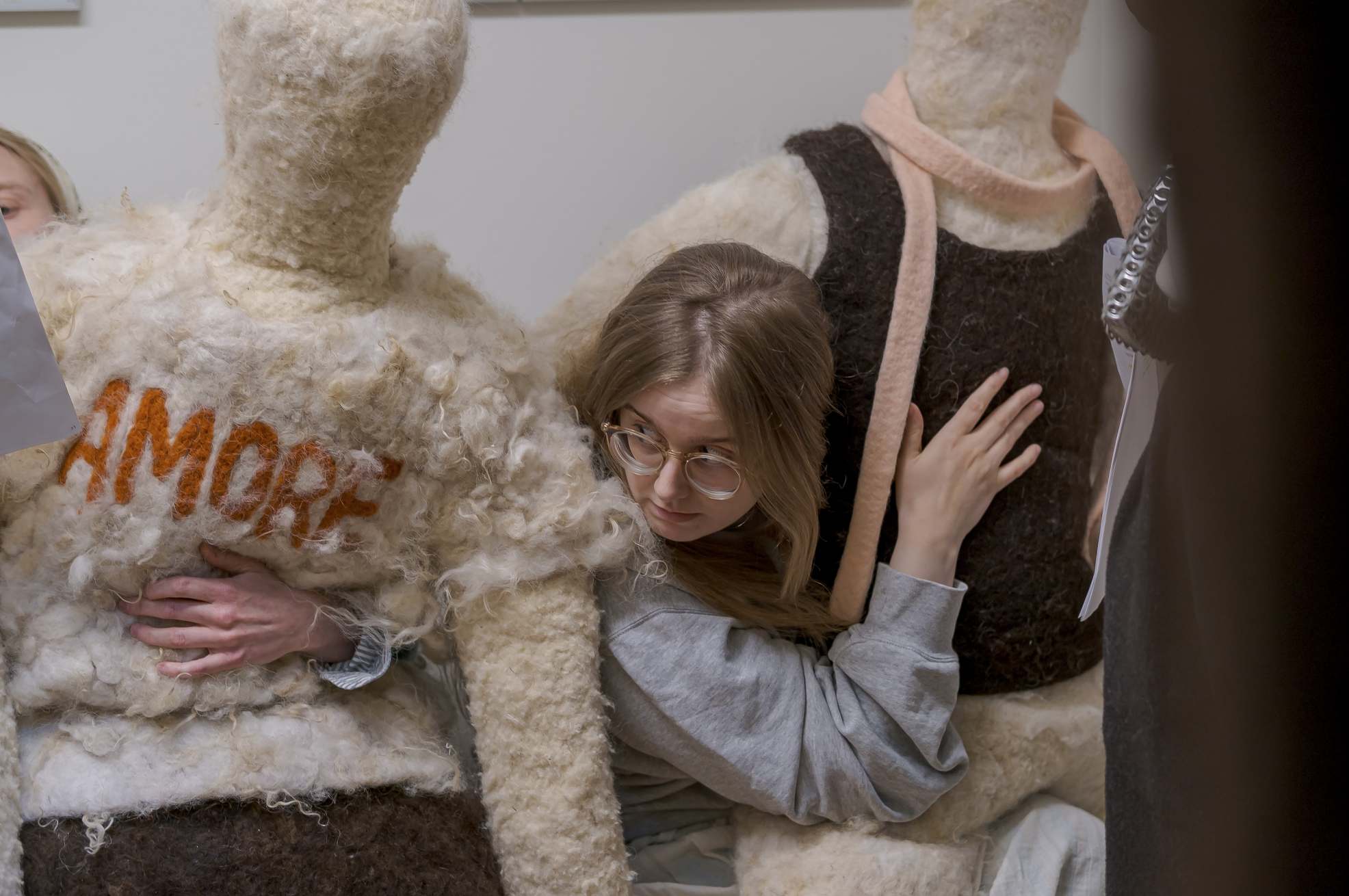
At exactly fifteen past, act four began. Four performers sat tightly on the bench, each embracing their woolen counterparts, and began to speak: “Life has a funny way of nodding to the future in the past.” The performance unfolded with a loose, conversational rhythm, yet beneath it ran a carefully constructed logic; one that allowed narrative, language, sound and time to slip across one another. What emerged was a story both witty and devastating, circling themes of childcare, loss and chosen family. The Icelandic word fóstur, meaning both “embryo” and the act of fostering, became a conceptual hinge. Care was neutral, but it was also entangled, possessive and porous. To foster is to take in, but also to claim as one’s own. The performers moved through these tensions with a lightness that never undercut the stakes, toggling between humor and vulnerability with disarming ease.
Folklore lingered in the work, less as a direct reference than as an atmosphere. At moments, it felt as though the voices belonged to 17th-century Iceland; at others, they seemed to speculate from some near or distant future. This temporal slippage sharpened the piece’s engagement with histories of care and abuse, particularly the phenomenon of baby-farming in Scandinavia. Though rooted in the past, the discussion resonated uncomfortably in the present, suggesting that such practices persist in altered forms. The critique was never didactic but instead it accumulated through fragments, echoes and repetitions.
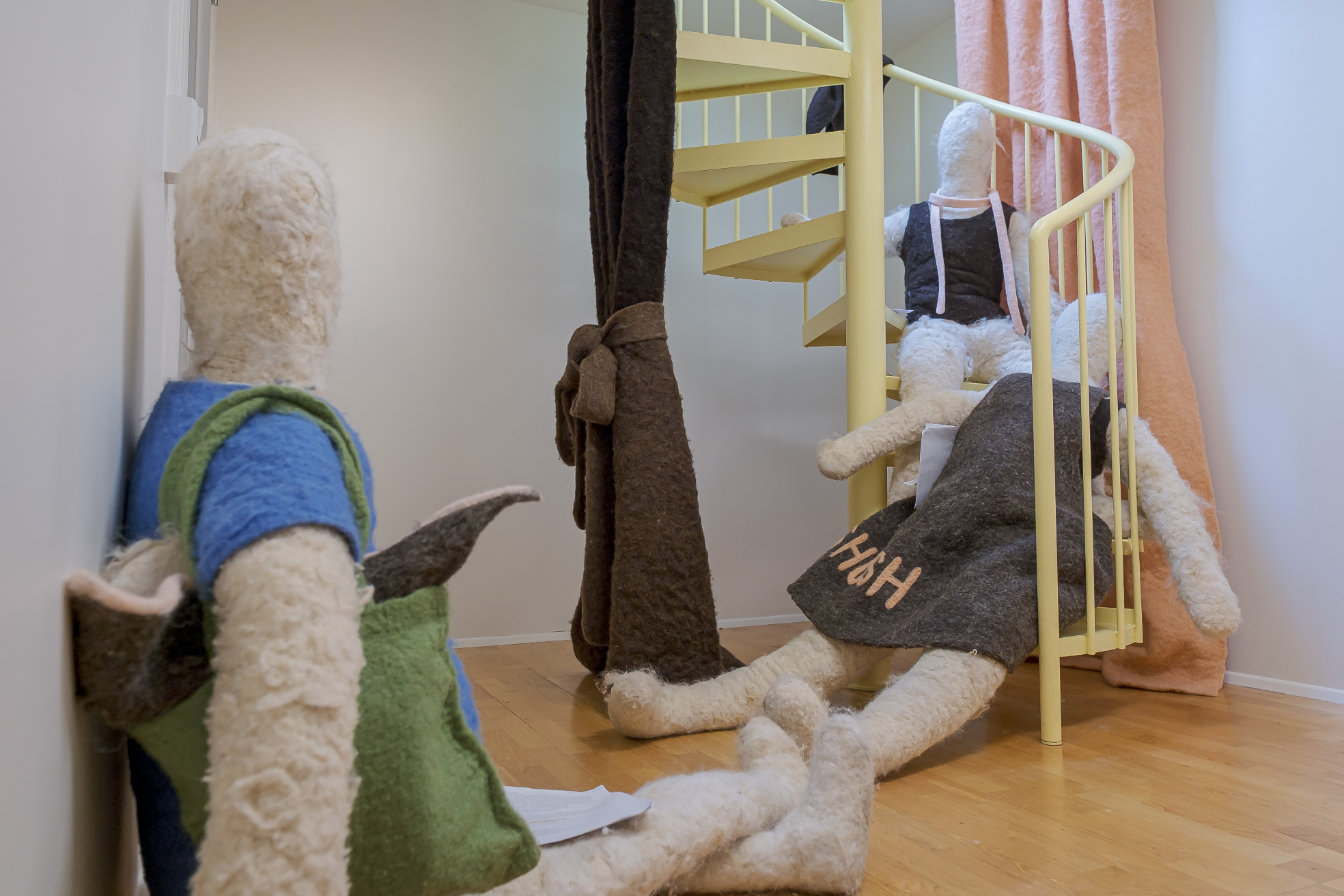
The staging was simple, but the handwork in the felted figures and the long curtains was striking. Short scripts hung on the walls alongside drawings of the characters, a generous offering, a kind of open score that allowed visitors to revisit the conversations or catch what they’d missed. Exchanges passed between the performers almost imperceptibly, as if voices were being shared or borrowed. Language itself became a site of play and layering, slipping between Icelandic and English. Afterwards, in conversation with my non-Icelandic-speaking friend, this multiplicity came into sharper focus. “What does little-pebble Halla mean?” my friend asked. Straumfjarðar Halla, I replied, already aware that the answer only opened up further meanings and conversations that would last the whole way home from Köllunarklettsvegur.
— Helena Solveigar Aðalsteinsbur
Images by Patrik Ontkovic
